

Congress announces ‘MGNREGA Bachao Sangram’
Highlights of Press Briefing of Shri KC Venugopal, MP and General Secretary (Org) AICC and Shri Jairam Ramesh, MP and General Secretary (Communications), AICC, address to the media at AICC Office, 24 Akbar Road, New Delhi, on January 3, 2025.
On 27th December, an important meeting of Congress Working Committee was held in New Delhi to discuss about the VB G RAM G law enacted by the Union Government. As Jairam rightly pointed out, there was a serious discussion, deliberation happened on that day about the future course of action against this new law. Congress Working Committee decided to launch a Nation-wide agitational campaign- ‘MGNREGA Bachao Sangram’ throughout the country.
Basically, the design of the new law is very clear to kill MGNREGA, which is one of the best demand-driven schemes of this country, poverty alleviation scheme of this country; not only in this country, internationally renowned poverty alleviation scheme.
Every year, 5–6 crore rural families found work in their own villages. Hunger reduced, migration declined, rural wages rose, and durable assets such as ponds, roads, canals and check dams were created. During drought, floods, Covid, economic crisis period, MGNREGA became the strongest safety net for the poor people of this country.
Women, Dalits, Adivasis and the most marginalised benefited the most. Women accounted for nearly 60 per cent of total workdays, gaining equal wages, income security and social dignity.
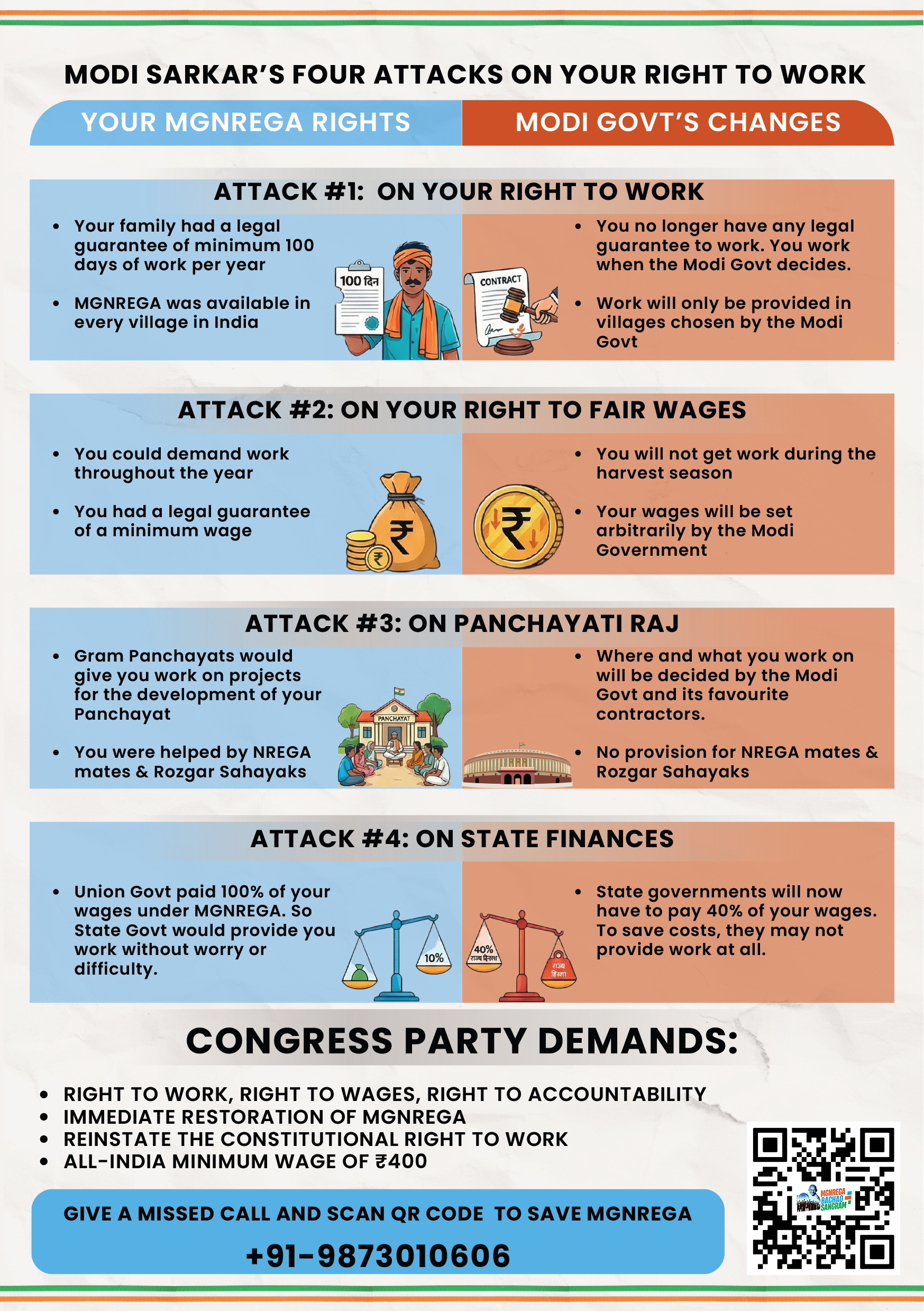
Under VB–GRAM–G, employment is no longer a right. Work will be provided only in Panchayats notified by the Central Government. If a Panchayat is not selected, people there have no entitlement to work, regardless of poverty or distress. This converts a constitutional promise into government permission.
MGNREGA was demand-driven. VB–GRAM–G introduces budget-capped “normative allocations”. Once funds are exhausted, work stops—no matter how desperate families are. This silently kills the legal right to work. Basically, MGNREGA was one of the most decentralized schemes. Now, everything Delhi decides, villages going to suffer. Earlier, Gram Sabhas and Panchayats planned works based on local needs. VB–GRAM–G centralises all decision-making—funds, works and assets—placing full control in Delhi.
Many Panchayats will receive zero funds, destroying the local planning and violating the spirit of the 73rd Constitutional Amendment. Basically, Panchayats are reduced to clerks, implementing centrally-designed schemes. The Bill introduces a 60-day blackout period during peak agricultural seasons. This means the government can legally deny work when rural distress is highest.
MGNREGA provided notified wages linked to inflation. VB–GRAM–G removes this certainty. There is no guaranteed wage rate—wages depend on what the Centre fixes for each Panchayat. This opens the door to underpayment and wage suppression, pushing workers further into poverty.
Earlier, the Centre paid 100 per cent of wages now that has been reduced to 60 percent. Poor and migrant-sending states are going to suffer it. What is the result? Result- deny work or divert funds from health, education and welfare activities. States have only that option.
Now, technology also, basically technology is the tool of transparency. Now, in this new scheme, technology is going to be a tool of exclusion. Workers with worn-out fingerprints, poor connectivity or low digital literacy will be denied wages. Basically, now, big thing is- in MGNREGA, there is no big contractor can enter, but now, the contractor space is provided. MGNREGA created village-level assets not covered under other schemes. VB–GRAM–G allows convergence with large infrastructure programmes like PM Gati Shakti.
It converts Panchayats into labour suppliers for central contractors, reintroducing contractors through the backdoor and increasing leakages. Their only claim is that they are increasing the days from 100 to 125 days. These are very bogus claims, which are not going to happen at all. If you reduce the wages from 100 percentage to 60 percentage, how can you expect that men days are going to increase- biggest false.
Who will suffer the most- the question, in front of our nation is:
• Rising rural unemployment, • Suppression of wages below minimum levels, • Increased distress migration and bonded labour, • Sharp decline in women’s participation, • Disproportionate impact on Dalit and Adivasi families, • Weakening of village economies, Then removing the name of Mahatma Gandhi is also the most condemnable thing. Mahatma Gandhi’s name is not symbolic alone. Gandhi represented dignity of labour, village self-rule and moral responsibility of the State. Erasing his name reflects an attempt to erase the rights-based vision behind MGNREGA itself.
Why the Congress has Launched ‘MGNREGA Bachao Sangram’-
• To defend the ‘Right to Work’ • Protect Panchayati Raj institutions • Stand with women, workers, Dalits, Adivasis and the rural poor • Take this issue to every village of this country.
Our clear demand is:
• Withdraw the VB–GRAM–G Act • Restore MGNREGA in its original, rights-based form • Restore people’s ‘Right to Work’ and Panchayats’ authority This is what Indian National Congress has been demanding through this ‘MGNREGA Bachao Sangram’.
Congress Working Committee has also given a clear-cut program to our PCCs to implement.
It will start on 8th January, 2026. 8 January 2026 – PCC-Level Preparatory Meetings will be held at PCC headquarters with the participation of Pradesh level leaders with the presence of General Secretaries/In-charges of the states. These meetings will focus on briefing the leadership on the implications of the VB–GRAM–G Bill, finalising district-wise responsibilities, identifying key speakers, and ensuring uniform political messaging and mobilisation planning for all phases of the campaign. On 10th January 2026 –District-level press conferences will be organised at all district headquarters to formally launch the ‘MGNREGA Bachao Sangram’. DCC Presidents and senior district leaders will address the media, explaining how the proposed law dismantles the ‘Right to Work’, weakens Panchayati Raj, suppresses wages and increases rural distress. 11 January 2026 – One-Day Fast-A one-day fast will be observed at district headquarters or near statues of Mahatma Gandhi or Dr B.R. Ambedkar. This programme will symbolise the Congress Party’s moral commitment to the dignity of labour and constitutional rights. Senior leaders, elected representatives, Party functionaries, social activists and MGNREGA workers will participate and engage with the public on the dangers of the VB–GRAM–G Bill.
12 January to 29 January 2026 – Panchayat-Level Chaupals and Mass Outreach • During this phase, Panchayat-level chaupals will be organised across all Gram Panchayats to directly engage MGNREGA workers, women workers, marginal farmers and landless labourers. The adverse impact of the VB–GRAM–G Bill on employment, wages and local self-governance will be explained. • Simultaneously, letters from the Hon’ble Congress President and the LoP (Lok Sabha) Rahul Gandhi will be personally delivered to Gram Pradhans, former Gram Pradhans, Rozgar Sevaks and MGNREGA workers. Vidhan Sabha-level nukkad sabhas and pamphlet distribution will be conducted simultaneously to reach wider sections of the population. This will happen between January 12 to 29. 30 January 2026 (Martyrs’ Day)- • On Shaheed Divas, peaceful sit-ins will be organised at ward and block levels with active participation of MGNREGA workers and grassroot activists. Observed on Martyrs’ Day, these programmes will emphasise non-violence, constitutional values and the importance of protecting the Right to Work. 31 January to 6 February 2026 – District-Level ‘MGNREGA Bachao Dharna’ • ‘MGNREGA Bachao dharnas’ will be organised at the offices of District Collectors/District Magistrates. DCC leadership, grassroot workers and MGNREGA labourers will participate in large numbers. Memoranda demanding withdrawal of the VB–GRAM–G Bill and restoration of MGNREGA in its original rights-based form will be submitted to the district administration. • On 1st of February, we will have a nation-wide strong protest. The details of that protest will be informed later. 7 February to 15 February 2026 – State-Level Vidhan Sabha Gheraos • This can be done in front of the Vidhan Sabha or Raj Bhawan or any of the central government offices which is convenient for the PCCs. • State-level gheraos of Vidhan Sabhas will be organised under the leadership of PCCs with large-scale, tens of thousands of workers, elected representatives and MGNREGA beneficiaries are going to participate in large scale Gheraos that is from 7 February to 15 February. • Finally, 16 February to 25 February 2026, the campaign will culminate with four mega zonal rallies organised by the AICC, bringing together participants from multiple States. These rallies will serve as a national assertion of the Congress Party’s resolve to defend the ‘Right to Work’ and rural livelihoods. Locations and dates will be communicated separately. • This is the program from 10 January to 25 February. We are going to hold around 45 day’s long national campaign- ‘MGNREGA Bachao Sangram’. We request to all media friends to cooperate for this massive program to enforce ‘Right to Work’ for the poor people of this country.
Indian National Congress
AICC Hq, Indira Bhawan, 9A Kotla Marg, New Delhi - 110002