

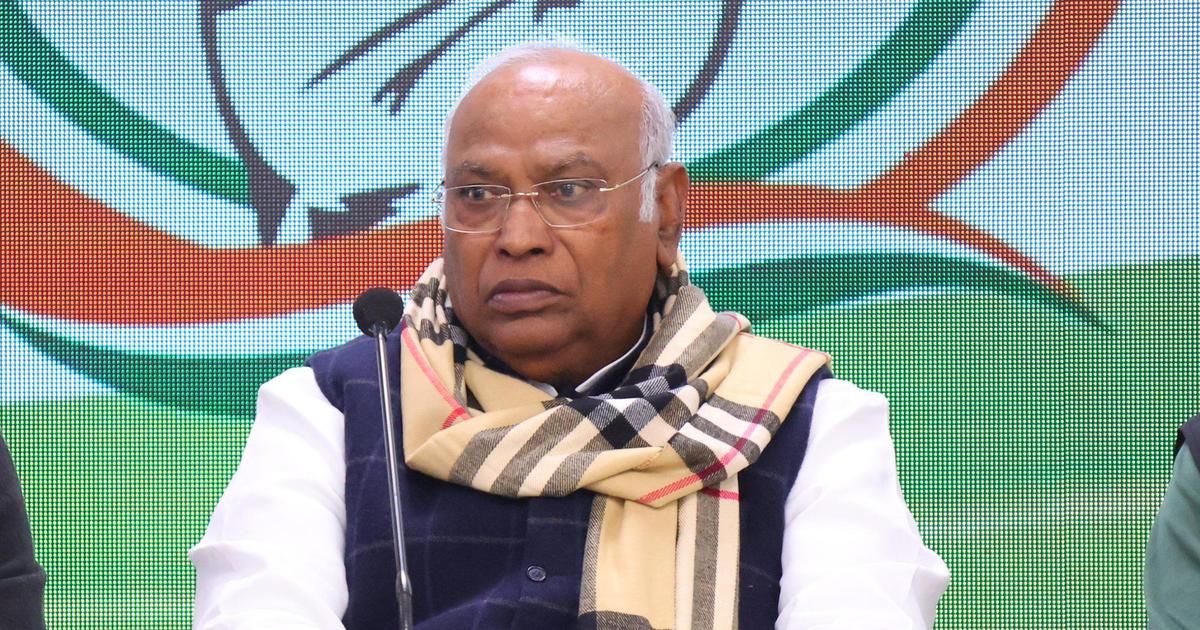
Congress President Shri Mallikarjun Kharge alleged, Govt. weakening democracy
Motion of Thanks on the President’s Address
Highlights of Speech of Shri Mallikarjun Kharge, Congress President & Leader of Opposition in Rajya Sabha, speaking in the Rajya Sabha on February 4, 2026, during discussion on the Motion of Thanks on the President’s Address.
Congress President and Leader of Opposition in Rajya Sabha Shri Mallikarjun Kharge on February 4, 2024, lashed out at the BJP government’s all-round failures on economy, foreign policy, social justice, growing inequality and rising unemployment.
Speaking during the ‘Motion of Thanks’ on the President’s address, Shri Mallikarjun Kharge said, it was silent on crucial issues such as social justice, social harmony, parliamentary democracy, the economy, farmers and laborers and foreign policy.
He said - Parliament is in session, and during this time, an India-US trade deal was finalized, but MPs learned about it not from their own government, but from President Trump. Trump is dictating what this country should do and how it should be run. On the recently concluded Indo-US trade agreement, he said that it was going to be detrimental to farmers, stating that it would increase pressure on small and marginal farmers and could affect the Minimum Support Price (MSP) system. In a scathing attack on foreign policy failure, Congress President said that it has been reduced to ‘event management’ and has weakened India’s strategic autonomy. He also expressed concern over China’s growing influence in neighbouring countries and the increasing trade deficit with China.
India’s trade deficit with China has reached a record high of 116 lakh crore rupees, and yet we are rolling out the red carpet for Chinese trade. While China continues to claim territory in Ladakh and Arunachal Pradesh after the Galwan incident and dictates economic relations with India on its own terms, this is detrimental to the country. Even when the government says that China was providing intelligence support to Pakistan after the Pahalgam attack, we are still welcoming them. He stated that the failures of foreign policy have also impacted internal security, resulting in loss of life and property due to terrorist incidents.
This emerges as a failure of internal security within the country. Since 2014, during this government’s tenure, there have been over 2,300 terrorist attacks, in which nearly 1,000 Indians have lost their lives. You want to use foreign policy as a weapon for domestic polarization. Such misuse for electoral gain is dangerous for both democracy and foreign policy. He said that the President’s address did not provide concrete answers to questions regarding women’s reservation, the implementation of the caste census, increasing atrocities against Dalits, tribals, and minorities, parliamentary accountability, and unemployment.
The Prime Minister’s Scheduled Castes Upliftment Scheme has an under-utilization rate of 41.59 percent. What happened with the Prime Minister’s Young Achievers Scholarship? There was an under-utilization of 31.51 percent, and in the Post-Matric Scholarship, it was 5.66 percent. This means that out of at least 6,360 crores, you fell short by at least40-50 crores, resulting in under-utilization. Who is responsible for this?
On the issue of social justice, the Leader of Opposition alleged that the women’s reservation law has been indefinitely postponed by linking it to the census, even as the government talks about women’s empowerment. He noted that the RSS had not yet given top leadership positions to any woman.
Over the past 11 years, the Modi government has weakened the fabric of social justice. While the President’s address spoke extensively about women’s empowerment, the truth is that women have merely been used as a vote bank by the BJP. If Mr. Modi truly wants to promote women’s leadership, he should immediately implement women’s reservation without any conditions.
On the caste census, Shri Mallikarjun Kharge said that the government initially opposed it, and even after accepting it, no clear roadmap, expert consultation, or discussions with states have been undertaken.
During Congress governments, several steps were taken for the economic development of the Scheduled Castes and Scheduled Tribes communities. The SC/ST Sub-Plan was created, but the Modi government weakened and ultimately dismantled many of these schemes. Now, the funds allocated to central government schemes for these communities are significantly reduced.
Questioning the utilisation of funds in SC/ST schemes, he said that a large amount of money remained unspent in schemes like the Pradhan Mantri Anusuchit Jaati Abhyuday Yojana, PM-YASASVI scholarship, and post-matric scholarships. On social harmony, Congress President Shri Mallikarjun Kharge cited the Manipur violence, saying that despite over 200 deaths and more than 70,000 displaced people, the role of the political leadership remained weak. He also objected to communal speeches, selective action, and ‘bulldozer politics’.
Regarding parliamentary democracy, the Congress President Shri Mallikarjun Kharge alleged that the importance of short-notice questions, half-hour discussions, and private member bills was being diminished. He disclosed that most questions related to the Prime Minister were not accepted in the 16th and 17th Lok Sabha. He stated that questions related to several important national issues—such as the statehood of Jammu and Kashmir, the inclusion of Ladakh in the Sixth Schedule, the Agnipath scheme, and Manipur rehabilitation—were rejected.
On the law-making process, he said that very few bills were referred to parliamentary committees during the current government’s tenure, thus weakening legislative scrutiny.
He said that the Prime Minister avoids questions in Parliament. You people don’t engage in discussions; these are the things you’re doing to destroy democracy. Questions on issues like statehood for Jammu and Kashmir or the Sixth Schedule for Ladakh were dismissed as hypothetical. Is giving statehood to Jammu and Kashmir hypothetical? During the UPA government’s tenure, in the 14th and 15th Lok Sabha, 315 out of 455 bills were sent to parliamentary committees. And in your government, the current government, only 77 out of 421 bills were sent to parliamentary committees, just 77! That’s only 19 percent. Is this your democracy?
On the economy, the Congress President raised the issue of rising inequality, stating that a large portion of the country’s wealth is concentrated in the hands of the top 1 percent, while the income and opportunities of the lower strata have decreased. He also referred to the government’s silence on the depreciation of the rupee and unemployment. He noted that millions of positions were vacant in the central government and that the government has failed to provide employment to the youth. He also expressed concern over the rising drug abuse.He also saidthat the Narcotics Control Bureau has seized 1.3 lakh kilograms of drugs in a single year. In the last 5 years, 65 percent of high-value drug seizures have taken place at ports in Gujarat alone. Where did it happen? At ports in Gujarat. Whose ports are these? - Oh, these come through Adani’s ports, and you can’t control it?
Referring to MGNREGA, Congress President Shri Mallikarjun Kharge said that it was being transformed from a rights-based scheme to a discretionary one, which will weaken the security of poor and rural labourers. He said that the UPA government made MGNREGA an entitlement-based program, providing a legal guarantee of employment to millions of workers on demand. Women benefited the most from this, and Dr. Manmohan Singh and Smt. Sonia Gandhi created a safety net that provided dignity and livelihood security to poor workers. Gram Sabhas (village councils) were involved in the implementation, and fund allocation was ensured according to the needs of the people. However, today the NDA government is creating a demand-based allocation system, and the funding pattern has changed. Previously, it was 10 percent from the state and 90 percent from the central government, but now it’s 60 percent from the center and 40 percent from the state. Is this fair to the states? Especially in Himachal Pradesh, which has very limited resources because it doesn’t generate much revenue, like Uttarakhand and other poor states, it will be difficult for them to manage, but the government has imposed this change anyway.
Indian National Congress
AICC Hq, Indira Bhawan, 9A Kotla Marg, New Delhi - 110002