



The Congress Party reaffirms its unshakable faith in Vande Mataram, ... the clarion call of our unity, and the voice of India’s undying spirit: Congress President
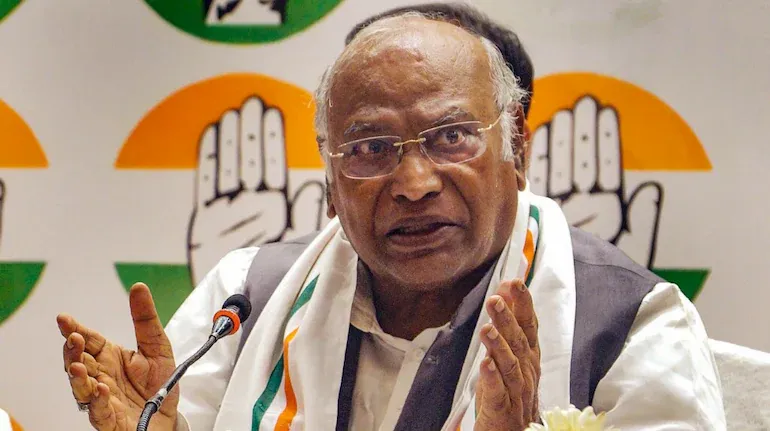
Message by Congress President, Shri Mallikarjun Kharge on the 150th Anniversary of India’s National Song - Vande Mataram on November 7, 2025.
Today marks 150 years of Vande Mataram — India’s National Song, that awakened the collective soul of our nation and became the rallying cry for freedom. Composed by Bankim Chandra Chattopadhyay, Vande Mataram embodies the spirit of our motherland, Bharat Mata, which is the people of India, and celebrates the unity and diversity of India.
The Indian National Congress has been the proud flagbearer of Vande Mataram. It was during the 1896 session of the Congress in Calcutta, under the leadership of the then Congress President, Rahmatullah Sayani, that Vande Mataram was sung publicly for the first time by Gurudev Rabindranath Tagore. That moment infused new life into the freedom struggle. The Congress understood that the British Empire’s policy of divide and rule, manipulating religious, caste, and regional identities, was designed to break India’s unity. Against this, Vande Mataram rose as a song of unflinching strength, uniting all Indians in devotion to Bharat Mata.
From the partition of Bengal in 1905 to the last breaths of our brave revolutionaries, Vande Mataram echoed through the land. It was the title of Lala Lajpat Rai’s publication, inscribed on Bhikaji Cama’s flag raised in Germany, and found in Pandit Ram Prasad Bismil’s Kranti Gitanjali. Terrified by its popularity, the British banned it, for it had become the heartbeat of India’s freedom struggle. In 1915, Mahatma Gandhi wrote that Vande Mataram had become the “most powerful battle cry among Hindus and Musalmans of Bengal during the Partition days. It was an anti-imperialist cry. As a lad, when I knew nothing of ‘Anand Math’ or even Bankim, its immortal author, Vande Mataram had gripped me, and when I first heard it sung, it had enthralled me. I associated the purest national spirit with it…”
In 1938, Pandit Nehru wrote, “For more than 30 years now, the song is related directly to the Indian nationalism. Such ‘songs of people’ are not tailor-made neither can they be imposed on the minds of people. They attain the heights by themselves.”
Therefore, a year earlier, in 1937, the Uttar Pradesh Legislative Assembly started reciting Vande Mataram when Purshottam Das Tandon presided as its Speaker. In the same year, the Indian National Congress, under the leadership of Pandit Nehru, Maulana Azad, Subhas Chandra Bose, Rabindranath Tagore, and Acharya Narendra Dev formally recognized Vande Mataram as the National Song, reaffirming its position as a symbol of India’s ‘Unity in Diversity’.
However, it is deeply ironic that those who today claim to be the self-proclaimed guardians of nationalism - the RSS and the BJP, have never sung Vande Mataram or our National Anthem Jana Gana Mana in their shakhas or offices. Instead, they continue to sing Namaste Sada Vatsale, a song glorifying their organisations, not the nation. Since its founding in 1925, the RSS has avoided Vande Mataram, despite its universal reverence. Not once in its texts or literature does the song find mention.
It is a well-known fact that the RSS and Sangh Parivar supported the British against Indians in the National Movement, did not raise the National Flag for 52 years, abused the Constitution of India, burnt effigies of Bapu and Babasaheb Ambedkar, and, in the words of Sardar Patel, were involved in Gandhiji’s assassination.
The Congress Party, on the other hand, takes immense pride in both Vande Mataram and Jana Gana Mana. Both songs are sung with reverence at every Congress gathering and event, symbolising India’s unity and pride.
From 1896 to the present day, every Congress meeting, big or small, from a Plenary Session or a Block Level meeting, we have sung Vande Mataram with pride and patriotism as a tribute to the people of India.
The Congress Party reaffirms its unshakable faith in Vande Mataram, the eternal song of our motherland, the clarion call of our unity, and the voice of India’s undying spirit. Vande Mataram! Jai Hind.
Indian National Congress
AICC Hq, Indira Bhawan, 9A Kotla Marg, New Delhi - 110002