



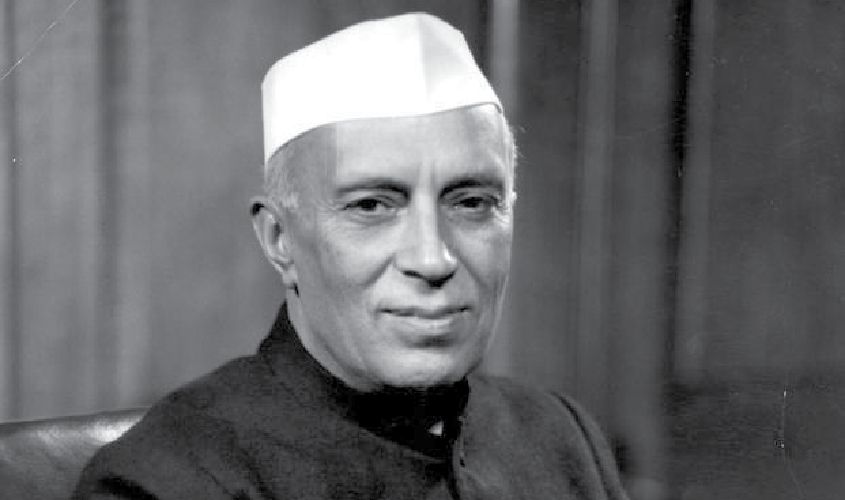
Pandit Jawaharlal Nehru was the most popular leader not only in India but in the world
- Dr. Shashi Kumar Singh Ph.d., D.litt.
Pandit Jawaharlal Nehru, fondly called “Chacha Nehru,” was not only a leading figure in the Indian freedom struggle but also immortalized in the world history as a symbol of peace, non-violence, democracy, and non-alignment. Throughout his life, he tirelessly worked to unify, modernize, and secure India a respectable place on the global stage. Nehru’s era (1947–1964) was a transitional period for India, as the country emerged free from the shackles of British colonialism. At that time, India was completely plundered and resource-depleted – with a gross domestic product (GDP) of ` 2.7 lakh crores, per capita income of $364, a poverty rate of 60-70 percent, a literacy rate of only 12 percent, industrial production of 10 percent of GDP, and dependence on agriculture of 70 percent, and agriculture itself was in a precarious state due to lack of resources. British rule had deindustrialized India, with GDP growth between 1850 and 1947 at a mere 70 percent (0.1 percent annually), and the devastating Bengal famine of 1943 resulted in 30 lakh deaths. Nehru inherited a faltering economy, but through his visionary policies, he revived it and put it back on its feet. Between 1950 and 1964, GDP growth was 4.4 percent, literacy rose to 28 percent, and the industrial base strengthened. He emphasized a mixed economy, public sector development, education, and science and technology, all of which remain the foundations of India’s progress today. Nehru’s foreign policy, especially the Non-Aligned Movement, gave India an independent voice in the midst of the Cold War, making him extremely popular globally. Many countries in Asia, Africa, and Latin America considered Nehru a source of inspiration for their liberation struggles. Considering the period, Nehru’s time was fraught with challenges. Partition, war, and poverty were rampant. Despite these significant challenges, he built India into a democratic republic, with GDP growth reaching 4.4 percent between 1950 and 1964.
Pandit Jawaharlal Nehru was the most influential leader of the freedom movement
Pandit Jawaharlal Nehru was a key pillar of the Indian freedom struggle, playing an active role from the 1920s. He became a close associate of Mahatma Gandhi and participated in the Non-Cooperation Movement (1920-22), where lakhs of Indians boycotted British goods. According to statistics, more than 30,000 arrests were made by 1921. Nehru founded the Independence League in 1927 and declared Purna Swaraj at the 1929 Lahore Congress session, which intensified the demand for independence. During the Civil Disobedience Movement (1930), he participated in the Salt Satyagraha, where more than 60,000 people were arrested. Despite Nehru’s arrest during the Quit India Movement (1942), his speeches inspired youth—more than I lakh people were arrested during the movement. Statistics show that Congress won 91 percent of the seats in the 1946 provincial elections, a major contribution to which was Nehru’s popularity. His books, such as ‘Glimpses of World History’ (1934, Vol. 2) and ‘Discovery of India’ (1946), provided an ideological foundation for nationalism. Nehru Ji included women and minorities in the movement, making the freedom struggle more inclusive. By 1930, women’s participation had increased by 10 percent. Under his leadership, India achieved independence in 1947, but Nehru held the country together amid the tragedy of Partition (10 lakh deaths and 1.4 crore refugees). Nehru’s contribution to the period is immense, as he inherited a plundered and resource-depleted India, which he restored and put back on its feet.
India’s Economic Situation after Independence
At the time of independence in 1947, India’s economy was devastated by British exploitation. Gross Domestic Product (GDP) was ` 2.7 lakh crores, per capita income was $364 (nominal), average annual growth was 0.1 percent from 1900 to 1947, poverty was 60-70 percent, literacy was only 12 percent, and industrial production was minimal (10 percent of total GDP). There was a 70 percent dependence on agriculture, 1.4 crore refugees arrived after Partition, and famine (30 lakh deaths in the 1943 Bengal famine) and unemployment were rampant. Nehru Ji inherited an utterly plundered, resource-depleted India, where deindustrialization had weakened the economy. Nehru Ji faced these challenges and initiated the Five-Year Plans. In the First Plan (1951-56), GDP growth was 3.6 percent, and irrigation area increased by 22 million hectares. Industrial growth was 4.1 percent in the Second Plan (1956-61), and 7 percent in the Third Plan (1961-66). Average GDP growth in 1950-64 was 4.4 percent, better than the 1 percent average during the colonial period. Per capita income growth reached 1.68 percent. Nehru Ji’s policies reduced poverty by 45 percent and strengthened the industrial base. Steel production increased from 0.1 million tons in 1950 to 3 million tons in 1964. He transformed a resource-depleted India into self-reliant one.
Pandit Nehru was the great architect of independent India
Pandit Jawaharlal Nehru is called the “architect” of modern India because he inherited a plundered, resource-depleted India. An agrarian state with a population of 340 million, literacy of 12 percent, and minimal industrial production, he unified. He contributed to the Constituent Assembly, which established secularism, equality, and democracy as its foundation. The Constitution, enacted in 1950, enshrined 26 fundamental rights. Nehru Ji prioritized science and technology, calling large dams like the Bhakra-Nangal (opened in 1955) “New Temples,” providing 1,000 megawatts of power and irrigating 1 crore hectares. A total of 20 large dams ensured the irrigation of an additional 4 million hectares by 1964. The establishment of IITs (Kharagpur 1951, Bombay 1958) and IIMs strengthened India’s global standing. Today, 10 lakh graduates from 23 IITs are bringing glory to India both nationally and internationally. Nehru Ji’s mixed economy promoted the public sector, leading to the establishment of steel plants like Bhilai (1955), which produce 1 million tons of steel annually. Total industrial production grew 7 percent annually between 1950 and 1964. His policies were based on social justice, which uplifted the poor. Land reforms distributed 2 crore acres of land. Nehru Ji’s vision was unparalleled during his time; he transformed a resource-depleted India and put it back on its feet.
India’s Great Architect
As the First Prime Minister, Nehru led India for 17 years. India was deindustrialized, poverty 70 percent, and literacy 12 percent. However, he strengthened Parliament, maintained an independent judiciary, and ensured freedom of the press. Congress won a landslide victory in the five Lok Sabha elections from 1950-64, winning 70 percent of the seats. Nehruvian socialism prioritized the public sector, leading to 7 percent annual industrial production growth between 1950 and 1964, with manufacturing accounting for 15 percent of GDP. For rural development, he launched the Community Development Programme (1952), covering 5 lakh villages – by 1964, 4,000 blocks had been established. He laid the foundation for the Green Revolution, which increased food grain production from 50 million tons in 1950 to 72 million tons in 1964, doubling wheat production. Nehru Ji initiated the nuclear programme (1954) and the space programme, which are the basis for ISRO’s success today. By 1962, 500 scientists were trained. Primary health centres were established. Life expectancy increased from 32 to 45 years. He provided a strong foundation for resource-deprived India.
Pandit Jawaharlal Nehru’s Popularity on the World Stage
Nehru Ji’s global popularity stemmed from the Non-Aligned Movement, which included 25 countries at the 1961 Non-Aligned Conference. He established resource-depleted India on the global stage, where his policies became a role model for newly independent nations. Nehru maintained India’s neutrality during the Cold War, actively participated in peacekeeping operations, and expanded its global influence. His popularity continued to grow in various fields.
Pandit Jawaharlal Nehru as a Successful Foreign Policymaker
Nehru Ji’s foreign policy was based on the Non-Aligned Movement, which expanded from 25 countries to 120 members in 1961. The ‘Panchsheel’ principles strengthened Indo-China relations, leading to the 1954 agreement. India played an active role in the United Nations, supporting the Hungarian issue (1956), and contributing 5,000 troops to the peacekeeping force. Nehru Ji’s policies established India as an ambassador of global peace, and his mediation in the Korean War (1950-53) was accepted. He is remembered as the leader who transformed a resource-depleted India into a global powerhouse.
Pandit Jawaharlal Nehru was the world’s most popular leader, whose vision transformed resource-depleted India into a global power. His contributions to the freedom struggle (91 percent election victory), reconstruction (4.4 percent growth), foreign policy (Non-Aligned Movement, Bandung Conference), education (28 percent literacy), and industry (7 percent growth) are timeless. Nehru Ji’s greatness is immense because he transformed resource-depleted India. Nehru Ji built India and laid the foundation for a strong India for the future, which inspires us even today and will continue to inspire us as long as India exists.
(The author is a member of the All-India Congress Committee and General Secretary and Organization in-charge of the All-India Congress Committee Vichar Vibhag)
Indian National Congress
AICC Hq, Indira Bhawan, 9A Kotla Marg, New Delhi - 110002