



Sarojini Naidu Congress President 100 years ago
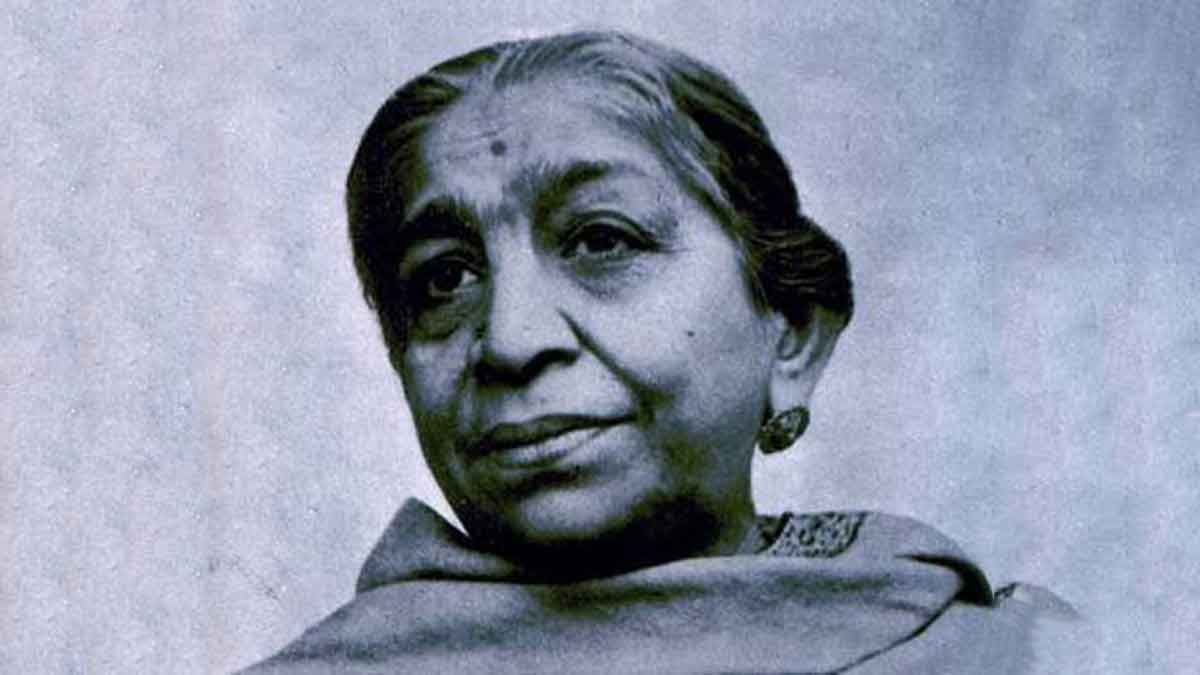
- Capt. Praveen Davar
The history of the freedom movement is replete with the saga of sacrifice, selflessness, courage and sagacity of great men and women. This struggle which gained momentum under the leadership of Mahatma Gandhi, in the beginning of the 20th century, threw up stalwarts like Jawaharlal Nehru, Sardar Patel, Subhas Chandra Bose, Maulana Azad, Rajendra Prasad, C Rajagopalachari and, earlier, Dadabhai Naoroji, Lokmanya Tilak, Gopal Krishna Gokhale, Madan Mohan Malaviya, Motilal Nehru, C.R. Das, Lala Lajpat Rai, and many more. But it was not a men’s movement. Many women played a proactive and prominent leadership role which was most visible when Annie Besant became the first woman President of Indian National Congress in 1916.
Sarojini Chattopadhyaya (surname before marriage) married Dr. Govindarajula Naidu in 1898 after her return from England and settled down in Hyderabad. The marriage become a landmark in social reform as inter-caste marriages were then almost unknown. Sarojini was deeply influenced by the Hindu-Islamic culture of her town, and gave expression to it in her poems. Some of her collection of poems which took the English world by storm were The Golden Threshold, The Feather of the Dawn, Bird of Time and The Broken Wing. Few of her poems were also translated into French. Sarojini’s innate longing for the ‘rapture of song’ could not prevent her from being drawn into the social and political life of the country. It was Gopal Krishna Gokhale who persuaded her to step out of her ivory tower. She met Mahatma Gandhi and Jawaharlal Nehru at the Lucknow session of the INC in 1916 and developed friendship with Rabindranath Tagore and C.F. Andrews. Earlier, at the INC session in Bombay (now Mumbai), Sarojini recited the following poem composed by her:
Awaken, O Mother! Thy children implore thee, who kneel in thy presence to serve and adore thee! The night is a flush with a dream of the morrow, why still dost thou sleep in thy bondage of sorrow? Awaken and serve the woes that enthrall us, and hallow our hands for the triumphs that call us.
Sarojini was deeply troubled by the rift between Hindu and Muslim communities. As much as Hindu culture, she admired Islamic culture and Muslim way of life. At the Lucknow session of INC in 1916, she played a notable role in bringing about cooperation between Congress and the Muslim league under the guidance of Lokmanya Tilak. Her association with Mohammad Ali Jinnah and Ali brothers made the task of Tilak much easier. She wrote that Lucknow sessions of INC and Muslim League marked a new era and inaugurated new standards in the history of modern Indian affairs.
Hindu-Muslim unity became a passion in Sarojini’s life mission. Addressing the seventh All-India Women’s Conference she declared: “No Indian could be loyal to the country and yet be narrow and sectarian in spirit… No matter whether it was temple or mosque, church or fire shrine, let then transcend the barriers that divide man from the man.”
In July 1919, Sarojini went to England as a member of the deputation of the All-India Home Rule League where she pleaded for the rights of women and supported franchise for women. In 1924, Sarojini visited Kenya, South Africa and East Africa as a delegate of the Congress and inspired Indian settlers in these colonies to fight for their rights non-violently.
In 1925, she was elected President of INC which became an inspiration for women to join public life. In her presidential address she declared: “No sacrifice is too heavy, no struggle too great, no martyrdom too terrible, that enables us to redeem our Mother from the unspeakable dishonor of her bondage….in the battle for liberty, fear is the one unforgivable treachery and despair the one unforgivable sin.”
Sarojini took a leading part in the Salt Satyagraha of 1930 and was sent to jail. In 1931, she accompanied Mahatma Gandhi to London for the Second Round Table Conference. She was imprisoned for the third time in the Quit-India Movement and was put in the Agha Khan Palace along with Gandhiji. After India became independent, she became the first woman to be appointed as a Governor. Sarojini Naidu also had a good sense of humour. Speaking to an audience of young scientists this is how she praised Homi Bhaba, later the Father of India’s nuclear programme, who was also present: ‘You are a true artist. Less than a month ago he (Bhaba) produced a picture of me. Though I do not praise myself, I do praise his talent. He made me look as ugly as I am. ‘She also had a message for the youth: ‘You are young and youth is the greatest of all gifts. I look upon you as one of those who have far to go and to raise the country and to let the country realise that knowledge is power and to use knowledge in the service of humanity is the beginning of wisdom.’ On March 2, 1949, she breathed her last at the Lucknow Raj Bhawan.
Pandit Jawaharlal Nehru in his homage stated: “Here was a person of great brilliance – vital and vivid. Here was a person with so many gifts, but above all some gifts which made her unique. She infused artistry and poetry into our national struggle…she represented in herself a rich culture into which flowed various currents which have made Indian culture as great as it is.”
(The writer is an ex-Secretary AICC, columnist and Editor, The Secular Saviour)

Indian National Congress
AICC Hq, Indira Bhawan, 9A Kotla Marg, New Delhi - 110002