



Subhas Chandra Bose as Congress President
- Capt. Praveen Davar
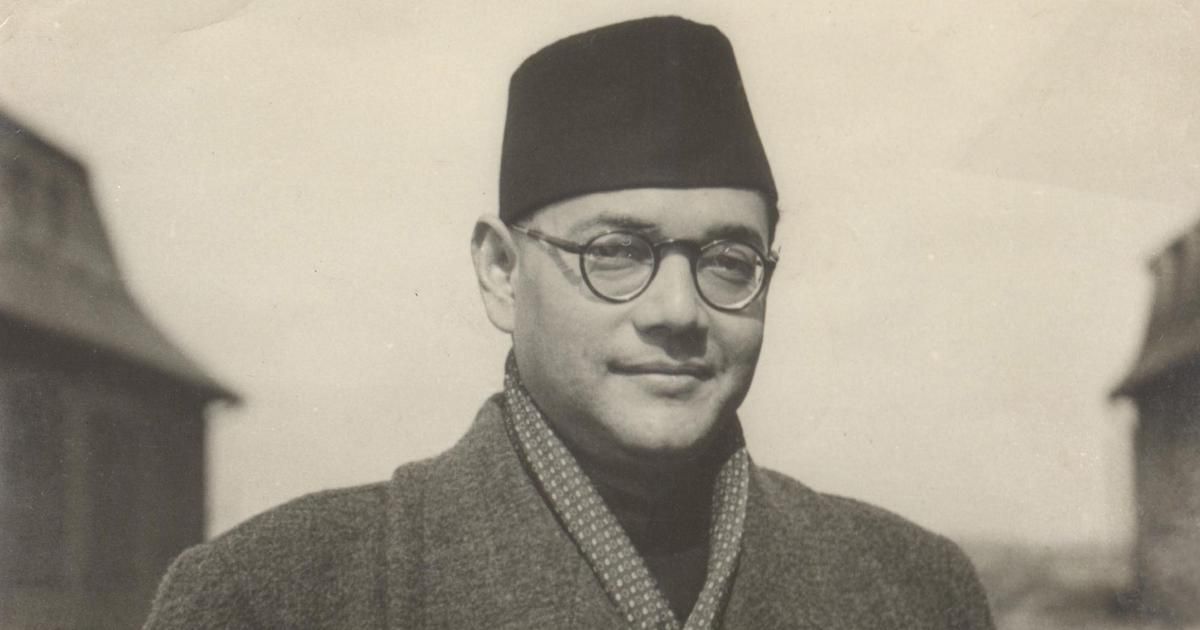
Subhas Chandra Bose, popular as ‘Netaji’ in his later years and after, was twice President of the Indian National Congress - in 1938 and 1939.
Born on 23 January 1897, he was forty-one year old when he presided over the 51st session of INC at Haripura (Gujarat). He succeeded Pt. Jawaharlal Nehru who was one year younger when he became Congress President for the first time at the historic Lahore session which had passed the resolution for Purna Swaraj (complete independence) in 1929. When Bose took over from Nehru, the latter had already been INC President thrice - 1929, 1936, 1937. Besides having similar views on planning, socialism and religious equality, both had by the decade of 1928- 38 become icons of the youth, including the revolutionaries like Bhagat Singh, Chandrasekhar Azad and Khudi Ram Bose.
Commenting on the Presidentship of Jawaharlal Nehru’s two consecutive terms- 1936, 1937- Bose in his autobiography, Indian Struggle- 1920- 42, writes: ‘Pandit Nehru’s Presidentship for two terms was marked by energy and initiative at the top and gave a fillip to the radical forces in the Congress...The years 1936-37 represented the high water mark of his popularity and in a certain sense, his position was then stronger than that of Mahatma Gandhi, because he had the support of the entire Left, which Gandhi had not.’
At Haripura, Bose began his maiden presidential address by paying customary homage to those who had passed away since the last session, including Swaruprani Nehru and Jagdish Chandra Bose: ‘Shrimati Swaruprani Nehru was to us not merely the worthy consort of Pandit Motilal and the revered mother of Pandit Jawaharlal Nehru. Her suffering, sacrifice and service in the cause of India’s freedom were such any individual could feel proud of... To Acharya Jagadish Chandra Bose, India will always remain beholden for being the first to secure for her an honoured place in the modern scientific world.’ Speaking on national unity to achieve the goal of freedom, Bose laid emphasis on the problem of minorities and assured the Muslims that they had nothing to fear in a free India: ‘There remains but one question which may be a source of anxiety to the minorities, viz., religion and that aspect of culture that is based on religion. On this question the Congress policy is to live and let live- a policy of complete non - interference in matters of conscience, religion and culture as well of cultural autonomy...The Muslims have, therefore, nothing to fear in the event of India winning her freedom. On the contrary they have everything to gain.’
To promote national unity, Subhas Bose was in favour of developing a lingua franca with a common script: ‘I am inclined to think that the distinction between Hindi and Urdu is an artificial one. The most natural lingua franca would be a mixture of the two such as is spoken in daily life in large portions of the country and this common language may be written in either of the two scripts, Nagari or Urdu.’ But then he expresses himself in favour of the Roman script: ‘I confess there was a time when I felt that it would be anti-national to adopt a foreign script. But my visit to Turkey in 1934 was responsible for converting me. I then realised for the first time what a great advantage it was to have the same script as the rest of the world... I am quite aware how unpopular the immediate adoption of the Roman script would be in our country. Nevertheless, I would beg my countrymen to consider what would be the wisest solution in the long run.’ Bose was re- elected as Congress President for the next session of INC at Tripuri (Madhya Pradesh), 1939 after what is inarguably the most controversial presidential election in the history of INC. He defeated Mahatma Gandhi’s chosen nominee, Pattabhi Sitaramayya in a closely contested election which led to the resignation of many members of the CWC. Netaji himself stated in his second presidential address: ‘The Presidential election this time was not of the humdrum type. The election was followed by sensational developments culminating in the resignation of twelve out of the fifteen members of the Working Committee, headed by Sardar Vallabhbhai Patel, Maulana Abul Kalam Azad and Dr Rajendra Prasad. Another distinguished and eminent member of the Working Committee, Pandit Jawaharlal Nehru, though he did not formally resign, issued a statement which led everybody to believe that he had also resigned.’ Earlier, Nehru had advised Bose not to seek re-election for two reasons: Firstly, it meant a break with Gandhiji which he did not want. Secondly, as the Left was not strong enough when a real contest came, it was bound to lose even if Bose was re - elected. Nehru also wrote to Gandhi to accept Bose as President: ‘You should accept Bose as President. To try to push him out seems to be an exceedingly wrong step.’ Comments Sankar Ghose in Jawaharlal Nehru - A Biography: ‘In this battle of wits neither yielded, but in the struggle for the mastery of Congress organisation Bose lost. He had to resign and was replaced by Rajendra Prasad.
The biggest contribution of Subhas as INC President was, inarguably, the setting up of the National Planning Committee which, after independence, became the Planning Commission. How ironic that the person he appointed as the Chairman of the Planning Committee - Pandit Jawaharlal Nehru- would head the Planning Commission as Prime Minister. On 19 October, 1938, Bose had written to Nehru, then in Europe: ‘You cannot imagine how I have missed you all these months... I hope you will accept the Chairmanship of the Planning Committee. You must if it is to be a success.’ As Sugata Bose, the grandnephew of Netaji, has written in His Majesty’s Opponent - Subhas Chandra Bose and India’s Struggle against Empire that Jawaharlal Nehru was the potential ally of Bose in this endeavour. By dismantling the Planning Commission soon after the 2014 general elections the Modi government thought they were erasing a legacy of Jawaharlal Nehru. They didn’t realise that this legacy also belonged to the leader they were trying to highjack, much like Sadar Patel, ignoring the fact that both Netaji and Sardar, though poles apart, were Nehru’s closest comrades, second only to Gandhiji. As Congress President, Bose also made efforts to improve relations between religious communities. He strongly believed that Hindu - Muslim unity was not only vital for the anti-colonial struggle but in free India there should be an equitable dispersal of power among religious communities. To this end he met Mohammed Ali Jinnah, President of the Muslim League on May 14, 1938, but the talks failed. He was also disappointed by his meeting later with VD Savarkar, the President of Hindu Mahasabha. In his autobiography, Bose writes: ‘From these interviews, the writer was forced to the conclusion that nothing could be expected from either the Muslim League or the Hindu Mahasabha.’ Both Jinnah and Savarkar, in his opinion, were collaborating with the British for prolonging the colonial rule.
As we pay homage to Netaji on his 147th birth anniversary let us not forget what Sugata Bose has written in the concluding page of his magnum opus: ‘Netaji has been subject to political appropriation, especially on the eve of elections. The Hindu Right lauds his military heroism, ignoring his deep commitment to Hindu - Muslim unity and the rights of religious minorities.’ A commitment, no doubt, shared with Gandhiji and other stalwarts of the freedom struggle.
(The writer is an ex-Secretary AICC, columnist and Editor, The Secular Saviour)
Indian National Congress
AICC Hq, Indira Bhawan, 9A Kotla Marg, New Delhi - 110002